
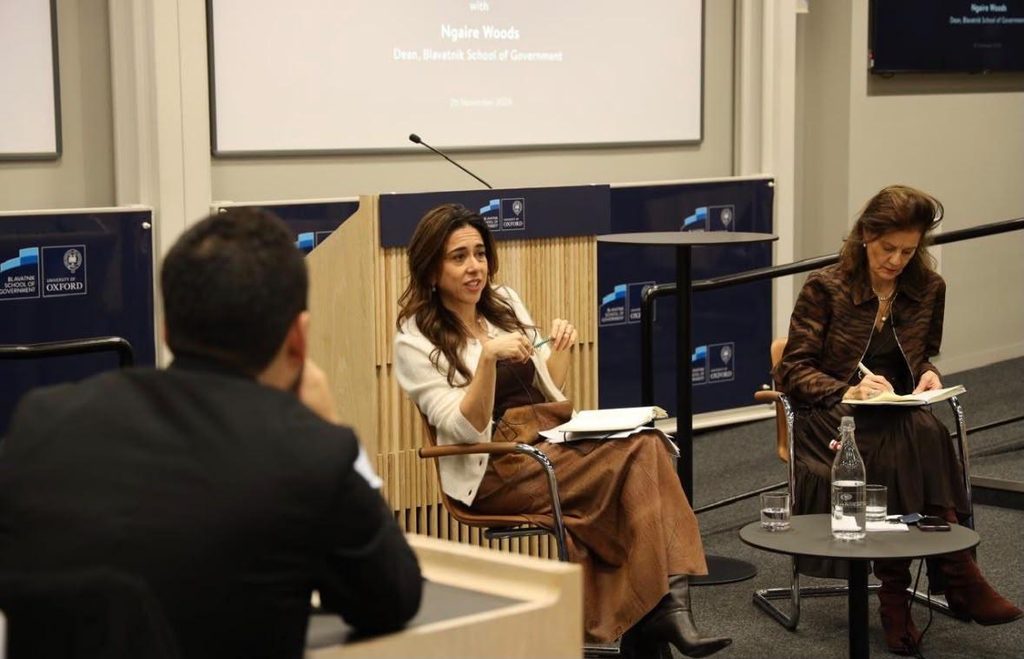
- Speaking to Oxford students, calls for UN reform that puts jobs for young people and the impact of technology at the centre of the development agenda
- Says the UN must regain credibility by delivering results in peace and mediation
- Sets out first-100-days focus on conflict, reform and rebuilding the organisation’s capacity to act
Oxford, 26 November 2026 – Candidate for United Nations Secretary-General Lana Nusseibeh today called for the UN to restore mediation to the centre of its work, setting out plans for a more active Secretary-General and an organisation focused on delivering measurable results for the generations who will inherit it.
Speaking to students at the Blavatnik School of Government at the University of Oxford, Nusseibeh said the UN faced a crisis of credibility and needed to demonstrate again what only a universal international organisation could deliver. She described it as “the first number that people think of calling, but also the last one that they really expect to answer.”
“The honest question is not whether the United Nations has fallen short. The answer to that question is that it has. The question is: what does the world still need it for?” she asked.
Restoring the UN’s role in peace and mediation
Nusseibeh said one of the clearest areas in which the UN had fallen short was conflict mediation, with regional actors and individual countries increasingly filling the space left by the organisation. “The idea of the Secretary-General as the UN’s mediator in chief has come up repeatedly in my consultations,” she said.
She said the Secretary-General had significant tools at their disposal, including advocacy, good offices, global relationships and the ability to put practical options before parties to a conflict.
Nusseibeh said she would prioritise conflicts where the UN could make the greatest difference in her first 100 days, backed by an empowered mediation team and more active senior leadership in the field.
“We need a Secretary-General with a high appetite for political risk because everything is moving very quickly,” she said. “A cautious approach, driven by a fear of failure, is not what we need at this moment.”
She pointed to Colombia’s 2016 peace agreement as an example of how the UN can add value without leading negotiations itself. The agreement ending more than five decades of conflict was negotiated with Cuba and Norway as guarantors, before the UN was asked to verify the laying down of arms, with UN observers collecting more than 7,000 weapons. “The United Nations knows how those agreements will last and how to make them just, predicated on the Charter and on international law”, she said.
Nusseibeh said the lesson was that the UN should support credible peace efforts led by others, while using its legitimacy and expertise to help implement agreements and connect them to longer-term political, development and peacebuilding strategies.
A UN built for the next generation
Addressing students, Nusseibeh said the UN needed to respond to a generation facing conflict, climate change and technological disruption at extraordinary speed.
Over the next decade, she said, 1.2 billion young people will enter the job market, while on current trajectories jobs will be available for only around a third of them. Artificial intelligence would also shape access to opportunity, she said, describing AI as potentially “the great divider or the great equaliser”.
Nusseibeh said the UN must also become an organisation in which the next generation wants to serve. “A lot of young people don’t apply to the UN today. They don’t think of it as a career option,” she said, adding that the next Secretary-General should bring new talent into the organisation and give young people greater agency in shaping its future.
Jobs, debt and a new development model
Nusseibeh said the UN must adapt to a changing development landscape, with official development assistance declining as countries face rising debt burdens, conflict and economic uncertainty.
“The UN will never be the World Bank or the world’s army,” she said. “Its job is to be the one table where those with the capital, those with the technology and those with the need sit as equals.”
She called for a closer standing relationship between the UN and international financial institutions, alongside greater mobilisation of private investment and philanthropy. Development support, she said, should respond to countries’ own priorities rather than follow a “cookie-cutter approach”.
She also highlighted the scale of the debt challenge, saying 113 countries now spend more servicing debt than on health and education.
Reform built around results
On UN reform, Nusseibeh said change must begin with a clear definition of what the organisation exists to achieve, rather than simply cutting costs or reorganising institutions.
“The UN desperately needs reform, but it has to be more than just moving boxes around on a chart,” she said. With around 4,000 active UN mandates, Nusseibeh said the organisation needed clearer priorities, less duplication and transparent measures allowing Member States to see what programmes cost and what they deliver.
“The Secretary-General has to model the behaviour we want to see across the organisation: accountability, transparency and a clear measure of what success looks like,” she said.
Africa and a new model for partnership
Nusseibeh identified the relationship between the UN and African Union as one of the major opportunities for the next Secretary-General, saying extensive cooperation between the two organisations had too often failed to translate into implementation on the ground.
She highlighted Security Council Resolution 2719, which established a framework for UN financing of African Union-led peace support operations. Putting it into practice, she said, could provide a test case for more flexible peace operations combining African leadership with UN resources and international support.
On Sudan, Nusseibeh said the immediate priorities were a ceasefire, full humanitarian access and a political process reflecting the democratic aspirations of the Sudanese people.
She added that an empowered UN mediation team should work with the Sudanese government and countries with influence over the conflict, using their influence to help bring the fighting to an end.
She also pledged to back UN accountability mechanisms and human rights reporting, saying the next Secretary-General would need to restore robust support for international law and the UN’s human rights pillar.
A UN that knows where it adds value
Closing the discussion, Nusseibeh said the next Secretary-General should spend more time in the field, support regional mediation where it is working and focus the organisation on areas where its legitimacy, independence and expertise can make a distinctive difference.
“The United Nations was never meant simply to agree with the world. It was meant to help the world agree,” she said. “We must give that sense of agency back to the United Nations.”
ENDS
About HE Lana Nusseibeh
Her Excellency Lana Nusseibeh is a candidate for Secretary-General of the United Nations and served as the UAE’s Permanent Representative to the UN from 2013 to 2024. She was UAE Minister of State and Envoy of the Minister of Foreign Affairs to the European Union and the United Nations, and has taken a leave of absence from her government responsibilities while pursuing her candidacy.
During more than a decade in New York, she twice served as President of the Security Council, as a Vice-President of the General Assembly and as President of the Executive Board of UN Women. Her diplomatic record includes work on Afghanistan, Gaza and UN reform, including Security Council Resolutions 2681 and 2720.
Her candidacy is built around a programme of UN reform focused on determined diplomacy, earlier action to prevent conflict, practical agreements that build towards peace, development that produces results countries can point to, consistent application of human rights and international law, and a more focused and accountable United Nations. Her Vision for the United Nations is available at www.lananusseibeh.org
For media queries, please contact:


